01
Fragmented Technologies
Specialized systems are fielded as disconnected components rather than one managed capability.
A113 DEFENSE / STRATEGIC BRIEFING
Transforming existing and next-generation platforms into intelligent, connected, mission-ready systems.
One modular architecture. Land. Sea. Air.
INTEGRATE. AUTONOMIZE. DEPLOY.
01 / The problem
Advanced technologies exist today, but integrating them into secure, reliable, operational systems remains a major challenge.
01
Specialized systems are fielded as disconnected components rather than one managed capability.
02
Closed interfaces constrain technology selection, upgrades, and long-term sustainment.
03
Bespoke integration makes each platform variant a new engineering effort.
04
Autonomy cannot advance safely without controlled interfaces, configuration baselines, and staged validation.
02 / The A113 solution
Integrate proven technologies into a flexible architecture that can evolve with mission requirements.
03 / Technology architecture
Data, power, commands, and mission applications connect through controlled interfaces and a documented configuration baseline.
Architecture layer 07
Operator workflows and mission-specific software
Interface Control Documents
Define ownership, boundaries, and behavior.
Configuration Management
Controls baselines, changes, and secure deployment.
Architecture elements represent an integration framework. Module maturity and validation depend on the selected platform, configuration, and program phase.
04 / Autonomy roadmap
Capability development stages—not formal certifications—provide a controlled path toward more advanced autonomous functions.
Deployable foundation
Remote control with human operators.
Human supervision · validation · safety qualification
05 / Land, sea & air
The integration discipline remains consistent while platforms, interfaces, and qualification requirements change by domain.
Near-term integration focus
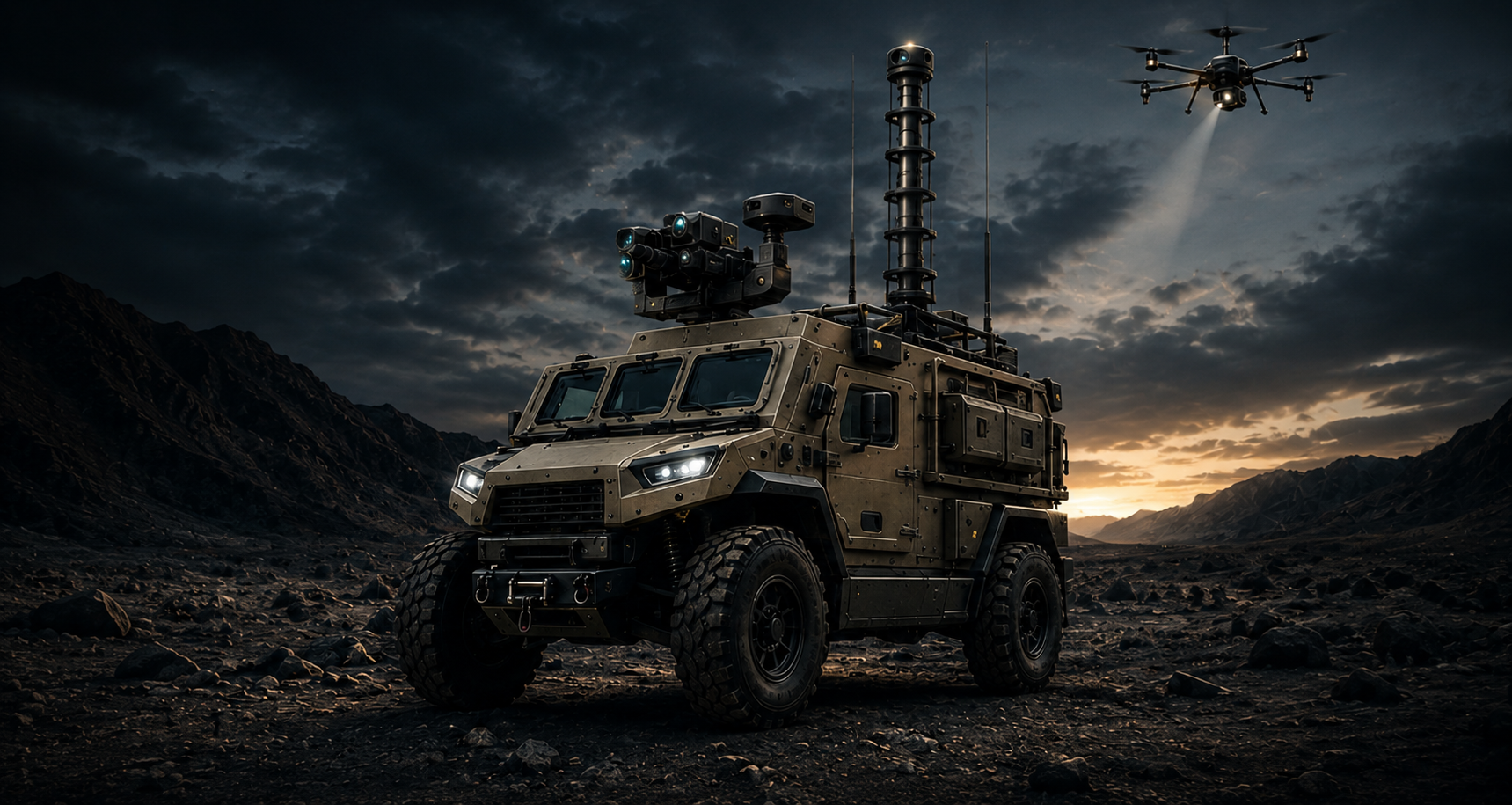
Mission Kit integration for tactical ground vehicles, autonomous logistics, robotic resupply, and mobile command systems.
06 / Competitive advantage
Conventional proprietary development
A113 Defense approach
Reduced cost, schedule, and supplier dependence are intended advantages of the architecture, not independently verified performance claims.
07 / Market opportunity
A113 Defense addresses integration needs across government mission platforms and commercial industrial autonomy without relying on unverified market-size claims.
Government markets
Commercial markets
08 / Traction & validation
2,000
A potential program opportunity under strategic discussion. This is not a purchase order, contract award, or guaranteed deployment.
09 / Business model
01
02
03
04
05
10 / 12-month execution roadmap
These are planned milestones and depend on customer requirements, selected technologies, platform access, and test outcomes.
Months 0–3
01
Finalize architecture, requirements, and platform interfaces.
Months 3–6
02
Integrate an initial ground vehicle Mission Kit.
Months 6–9
03
Conduct controlled demonstrations and field testing.
Months 9–12
04
Pursue customer validation, contract opportunities, and production readiness.
11 / Leadership & execution
Leadership experience spans U.S. military service, defense technology strategy, aerospace and energy systems, advanced technology commercialization, systems integration, government procurement, business development, and strategic program execution.
Executive profile
Detailed executive biography and professional portrait are available for qualified strategic discussions.
12 / Strategic growth
01
Tactical ground vehicle integration and controlled demonstrations.
02
Repeatable Mission Kit configurations, production integration, and expanded mission applications.
03
Deliberate expansion into maritime and aviation systems, advanced autonomy, and fleet modernization.
13 / Strategic inquiry
A113 Defense is building the systems integration foundation for intelligent, adaptable, and increasingly autonomous mission platforms.